
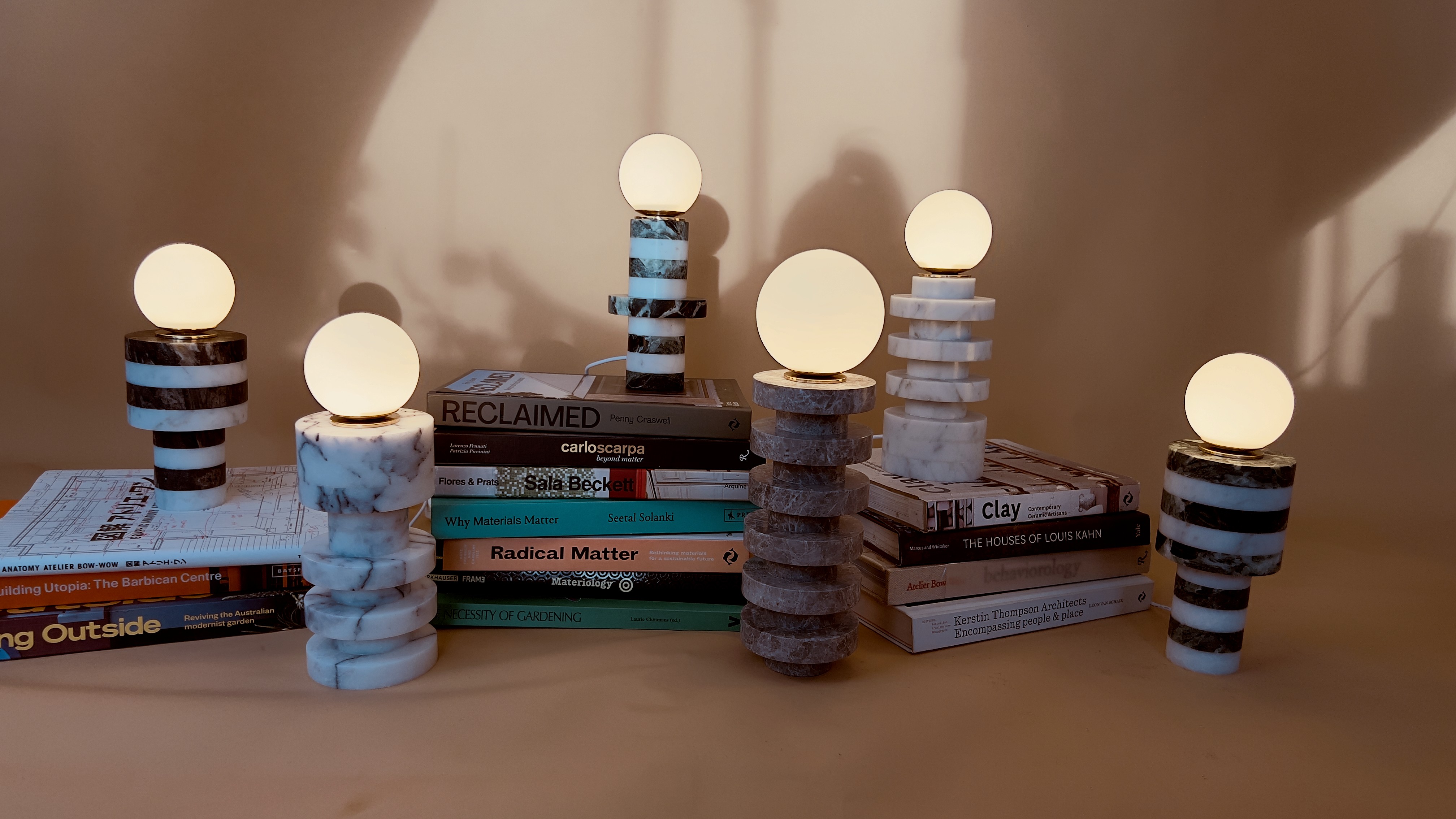


Odds & Ends
Year
2022
Typology
Lighting
Odds & Ends began through repeated visits to local stonemasons and fabrication yards across the Gold Coast. During these visits it became difficult to ignore the volume of marble being discarded, particularly smaller offcuts and fractured remnants produced during kitchen and bathroom fabrication. Despite often containing the most expressive veining and material character, these fragments were typically considered too awkward, fragile, or geometrically inconsistent to reuse conventionally.
The project emerged from a simple observation made while transporting these offcuts stacked loosely in the back of a vehicle. As the pieces shifted and layered against one another, the resulting striped formations became more compelling than the individual stone fragments themselves. What was originally waste began to read as a new architectural surface assembled through repetition and accumulation
From this point the work evolved into an ongoing exploration into how irregular material can be reordered through simple geometric systems. Circular stone discs are stacked, rotated, and layered around concealed structural cores, allowing fragmented waste material to regain coherence through assembly rather than monolithic form. Shadow gaps between each layer deliberately exaggerate the stacked reading of the objects, reinforcing their construction from many smaller parts.
The series draws interest from both architecture and object making. Geological irregularity is held within clear and repeatable systems, creating a tension between expressive natural material and controlled geometric order. While the forms remain relatively simple, the objects explore broader questions around material value, repair, reuse, and the strange thresholds where waste begins to regain meaning.
Rather than treating sustainability as a visual language, Odds & Ends attempts to work directly with the overlooked realities of fabrication waste. The project proposes that discarded material does not necessarily require disguise or refinement to become useful again, only a different way of seeing and assembling it.


